12 Min Read
January 28, 2026
By
Helios is an EH interview series about new research in the energy humanities and the creative processes that bring it to life. In this sixth installment, Amy Janzwood speaks with Darin Barney about her book Mega Pipelines, Mega Resistance: Tar Sands, Social Movements, and the Politics of Energy Infrastructure (UBC Press, 2025).

Amy Janzwood is an Assistant Professor, Political Science and Bieler School of Environment, McGill University. Darin Barney is Professor and Grierson Chair in Communication Studies, Art History & Communication Studies, McGill University. Both are members of the McGill Energy Centre.
We are pleased to share a conversation with Amy Janzwood and Darin Barney on her recently published book with UBC Press, Mega Pipelines, Mega Resistance: Tar Sands, Social Movements, and the Politics of Energy Infrastructure (available open access). This conversation took place at the book’s launch at McGill University on November 26th 2025, and has been shortened and edited for clarity.

Darin Barney: Thanks for inviting me to have this conversation with you. I don’t think I’ve read a book recently that was more resonant with my longstanding interests. And really, I just want to say congratulations. I think this book will stand the test of time as the definitive account of this episode in not only pipeline politics in Canada, but resource politics more generally. The depth of research and the level of detail and precision in the analysis, I think is just remarkable relative to everything else that’s out there on these topics. I also want to say that I think it stands as a model to energy scholars, resource scholars and social movement scholars of how to do research around complex events and topics such as this. It’s not just the historical and institutional and political and analytical detail, but also the way you approach this complex terrain is, I think, exemplary. So just thank you and congratulations on behalf of all the people who are now going to read this book.
I want to start by focusing on one of the central characters here – pipelines themselves. Because reading the book, I was just repeatedly struck by what I take as the distinctive character of pipelines as objects, as sites, and even as media, I would say, of political attention and mobilization and contestation. It seems to me they’re a very, very distinctive thing. The first question I want to ask you is, what is it about pipelines that makes them so political? And maybe phrased in another way, what are pipeline politics about?
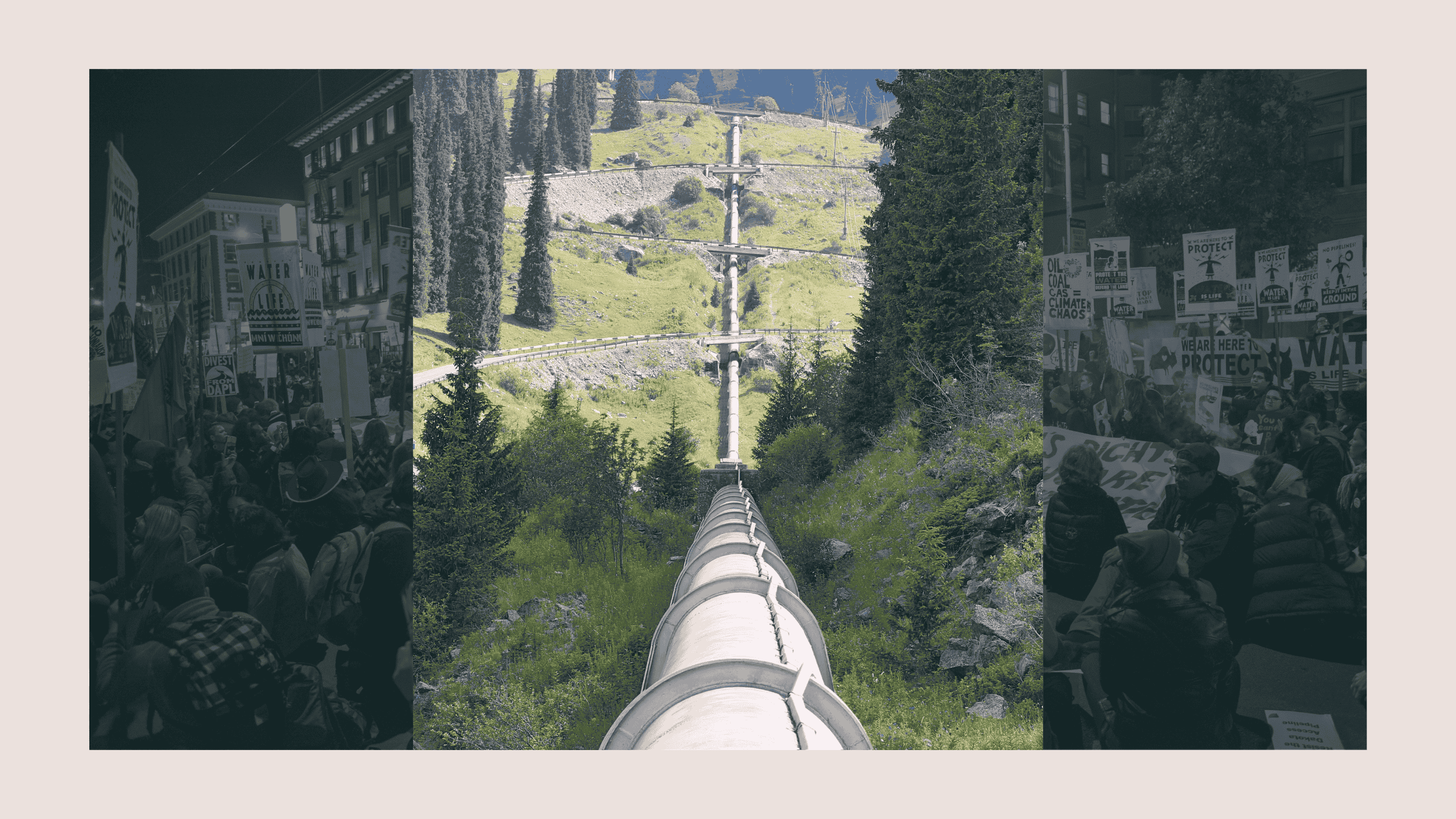
Amy Janzwood: What a small question to start! Pipelines are so many things, right? They’re political, technological, and financial feats. They involve so much political work from advocacy and regulatory process, PR, framing and messaging, to the work of negotiating with First Nations, with communities, to the role of the state, which we’ll get to, which looms very large in both of these pipelines and others as well. But pipelines are very vulnerable to disruption. They are infrastructure that crosses many territories, many boundaries. They are uniquely vulnerable to mobilization from different groups with quite different interests, which is why there’s this particular coalitional politics that was quite amenable to the struggle around pipelines. Pipeline executives, when I interviewed them, were quite surprised at the resistance there was to pipelines, and they said, ‘they’re invisible, they’re buried in the ground’. And it’s the work of pipeline activists to make the risks and the costs that they perceive of these projects visible. Tanker traffic though of course is very visible. But part of the materiality of pipelines is a struggle to make risks visible when projects are ultimately built – which are ‘invisible’ until they might spill.
There’s also a temporal aspect – what we’re talking about are ideas of pipelines and ideas of particular economic futures. Another job of pipeline opponents was to collapse time here and to bring these future risks to the present, which had certain challenges. Those are some of the dynamics. And we can get into the specific frames around and concerns, for example, around spill risk, Indigenous sovereignty, and climate. But it’s really this future prospect and what that entails, and contesting that future as well.
Darin: I’m looking at my little list here of the answers to this question that I drew from your book. So pipelines are about economies and economics, about environments, about energy. They’re about jurisdiction. They’re about rights. They’re about interspecies relations. They’re about identity. They’re about land and water, they’re about risk, toxicity, and environmental justice. They’re about distant pasts and also imagined futures. They’re about democracy. These are all the themes that just come flying out of Amy’s book. And so is that an asset for social movement politics? That is to say, this kind of multiplicity of things that pipeline politics can be or are about, or is that a challenge insofar as the diverse actors involved in the coalitions that you described have to struggle to define what the issue is? Or does the way in which pipelines resist being reduced to a single issue actually become a kind of asset for the social movements that you described that arise to resist these developments?
Amy: I think on the whole, it’s definitely a benefit to movements, but it’s certainly not taken for granted that organizations would be able to agree to work together. There are tensions, things that need to be navigated and negotiated around claims to land and Indigenous sovereignty and what it means to ally with Indigenous nations. It was organizations’ experiences in the regulatory process that made the pipeline also about democracy. One of the things I try to do in the book is to show that we cannot assume that these movements will be successful. But the fact that pipelines are about so many of these things, we shouldn’t be surprised to see there’s a lot of potential for mobilization. But there are conditions that need to be in place for that mobilization to form and be successful.
Darin: There’s one thing that I didn’t put in that list that I rattled off that pipeline politics are usually about. For many people, I think especially people who live at a distance from Alberta and British Columbia in Canada and internationally, the politics of pipelines are about climate change. And maybe, as the title of the book suggests, about the relationship between the tar sands and climate change. And one thing that struck me in reading the book was the complex and maybe even ambiguous relationship between the issue of climate change and the politics of pipeline resistance. So I want to ask you to say a little bit more about how coming out of these two cases, you would describe the place or role of climate change as a motivating or organizing factor in the Northern Gateway and Trans Mountain expansion struggles.
Amy: It was really not at the surface for Northern Gateway. There’s a bit of a temporal dynamic where the Northern Gateway pipelines project was first in the early 2010s. This was before the Paris Agreement, before climate had the salience that it did. But organizers that I talked to, who maybe were personally also motivated for climate, knew that those were not the risks that were most salient for the communities that they were embedded within. It was really about concerns around water, the risks of spills, the impacts of heavy bitumen in marine environments, of which very little was known. Those were the issues that were really at the forefront of connecting different organizations that were involved in the coalitions.
Climate was more prominent in the Trans Mountain Expansion (TMX) case in framing, but importantly, the regulatory process was part of the reason why climate was not at the forefront. Some folks are surprised to know that it was not possible to talk about – it was literally not allowed to talk about – the climate impacts of these projects and the regulatory process. And in the case of Trans Mountain, there were 26 experts who wanted to talk about climate who were barred from that process. So that’s one of the reasons why climate was really in the background of a lot of this.
Concerns around spill risk and Indigenous sovereignty and rights were at the forefront in the framing of these projects. There’s also this broader question of whether pipelines and climate goals are compatible. And that was certainly something as the Trans Mountain process unfolded – as constrained as it was – we heard repeatedly from the federal government that these could be compatible. There was never really a moment where the government showed its math, and some of the assumptions that it was using to make these claims have been readily critiqued.
It’s no surprise that when you hear public opinion surveys that Canadians are concerned about climate and Canadians also want another new pipeline, this is not in fact contradictory, and is very much the result of a framing from political elites, including the federal government, suggesting that there is compatibility here. The federal government went so far as to suggest that the Trans Mountain, when the government purchased it, would fund Canada’s clean economy, which the government knew was not true. They will not be making money on this project. But that is the doublespeak around these projects and climate. And we really haven’t seen a clear kind of accounting or reconciling. In part because the regulator didn’t want to touch it, and the federal government, now owning the project, also doesn’t want to really make that assumption or that assessment.
Darin: I’m thinking about another thing that you mentioned, which is a relatively brief part of the book – the rise of new forms of resource populism in the region, but elsewhere too. This is interesting, given what you have just said about climate change not necessarily rising to the top of the set of issues that produce the intersections for the diverse interests of pipeline resistance coalitions. Do you think that the way in which climate concerns in some ways dominate concern about pipelines at a distance hurts some of the more regionally specific movements in resistance to pipelines in the sense that this is part of the fuel for the resource populisms that are taking up so much space?
Amy: That’s an interesting question. Yes and no, because the other part of the resistance is resistance specifically to tar sands expansion. There has been this frame of the problem, and the oil/tar sands being the problem, for a bunch of reasons. Narratives of extractive populism have been able to play into this narrative that Alberta is the victim, Alberta is under attack. Successive premiers have said as much, that their interests are being held hostage by foreign-funded radical NGOs, of which there was a commission funded by the Kenny government in 2019 that found that citizens were exercising their rights of free speech. But that is a very powerful narrative. So I think it’s certainly part of that. It goes beyond the climate as well.
Pipelines are infrastructure that crosses many territories, many boundaries. They are uniquely vulnerable to mobilization from different groups with quite different interests.
Darin: Let’s focus now on what I think is the kind of central concern of the book, which is social movements. In some ways, it’s a book about pipelines. It’s a book about the tar sands. And it’s also a book about social movements, and this is announced by the title, obviously, Tar Sands, Social Movements and the Politics of Energy Infrastructure. So if I asked you to list three things that we learn from your book about the politics of social movements in the contemporary period, or that social movements might learn by reading your book, from the account that you give of the Northern Gateway and Trans Mountain expansion struggles specifically, what would those three things be?
Amy: If you’re in movements, this might not be surprising, but one thing that I found in the book was the strong foundations for movements, the social ties that they had developed from other advocacy campaigns allowed them to mobilize very quickly around the Northern Gateway project. With movements having that first-mover advantage in terms of framing – dirty oil in particular – was very effective. Enbridge was unprepared and very surprised by the amount of opposition. That was only possible because of a history of resistance and particularly alliances between Indigenous groups and environmental organizations around campaigns, including the Great Bear Rainforest, campaigns against fish farming, against oil and gas offshore exploration in BC, which dates back to one of the original reasons for the tanker ban. For those reasons, it allowed the coalition to form very quickly and stay together in Northern Gateway. And I don’t want to paint the picture that there was no conflict or that there were no tensions, but certainly that history mattered – you didn’t have the history of organizations working together against Trans Mountain in the same way, and so they definitely had a much more challenging context to work.
And the coalition members/organizations used a number of strategies – most were mutually reinforcing, but not all of them were effective or successful. There was a strategy at one point to have mass public engagement in the regulatory process. That really backfired when the federal Harper government then changed how the regulatory process worked and constrained it. And the Trans Mountain process was a direct result of that. Engaging with investors, for the most part, was not very effective until there was a tipping point in the case of Trans Mountain. Then investors became quite scared and started calling folks in the coalition and asking how serious these risks really were. Having multiple strategies, including research on bitumen behaviour in water, canvassing, regulatory advocacy and policy work around the tanker ban, all these things, fighting in the courts. And having a successful movement while you’re fighting a project in court is also not easy, because the attention usually dissipates. Because there were so many groups involved, the movement maintained momentum, even when things were in the courts.
And then the last thing I’ll say, which I think is important in this political moment, is that these movements were very good at surviving political attacks. This was under, in the case of Northern Gateway – particularly, the Harper majority government years – where the government literally labelled these groups ‘enemies’ in internal documents and basically said as much publicly. There were targeted political audits of charities. There were attacks that these were foreign-funded radicals. So there were a number of things that made for very difficult political conditions. But it was the fact that coalitions had these intercommunication networks and channels to work with one another to decide which organizations would be upfront and risk the backlash, and which organizations were going to work more behind the scenes. A lot of movements and organizations right now are very resource-constrained. The Harper government’s attacks actually boosted fundraising for some of these organizations. Some of those lessons might be relevant in this political moment, but this is a much harder political moment – given the changing geopolitics and very reassuring but misleading messaging around energy security, and surging extractive populism and petro-nationalism – it’s challenging for a different set of reasons.
Darin: This prompts me to ask the next question I’ve been thinking about, and that I think again, just jumps out of the book. The book is primarily about social movements, but it also tells a kind of parallel story about the role of the Canadian state, I think, in both its provincial and its federal variants, and specifically about the role of the Canadian state in relation to pipeline projects and perhaps resource development and energy transition more broadly. So based on your accounts of the Northern Gateway Pipeline project and the TMX project, I want to invite you to say something about how you would characterize what the state is and what it’s for and what it does in relation to pipelines, the resource economy, and maybe energy transition in Canada more broadly?
Amy: This is a great question, and the state looms so large in all of this. I’ll talk about the federal government mostly, and the deep entanglement between the fossil sector and provincial government allies. The state is much more than a regulator in these cases. In some cases, it’s a financial backer. It is making policy pathways to get pipelines built. It is a security partner. And it is extraordinarily powerful.
I’ll say three things. There is a very coercive dimension of resource politics, what Crosby and Monaghan call the security state. The criminalization of, in particular, Indigenous land and water defenders, the surveillance of these movements, disproportionately Indigenous surveillance of Indigenous activists. The injunction regime has had increasing penalties over time, particularly in the BC context, as a direct result of civil disobedience, opposition and land defense to pipeline projects. Crosby and Monaghan’s excellent Policing Indigenous Movements, for example, talks about the very close relationship between the Canadian Security Intelligence Service and oil and gas companies and pipelines. More recently, there’s the RCMP’s Community Industry Response Group, C-IRG, which has recently rebranded. But this was formed directly in response to fears of mass resistance around the TMX and Coastal GasLink, like the Sacred Stone Camp on the Standing Rock Reservation in response to the Dakota Access Pipeline (DAPL). C-IRG is a militarized, specially trained part of the RCMP that’s responsible for intervening in conflicts between Indigenous communities, local communities and the energy industry in BC. They were involved in the Wet'suwet'en, in arresting land defenders, and Kanahus Manuel, who was one of the foremost Indigenous land defenders around Trans Mountain. There’s been some really good work by Research for the Frontlines, revealing the work of C-IRG. C-IRG is undergoing federal investigation – there have been hundreds of complaints – and I’m not sure where that will go. But there’s a very deep, long history of surveillance and criminalization, particularly of Indigenous activists.
There’s also the state’s enormous financial power and resources – part of what Kyla Tienhaara and Jeremy Walker call fossil capital’s nationalist turn. Canadian states, both federal and provincial, have committed themselves at one point or another to purchasing outright or financially supporting contested mega fossil fuel infrastructure, including Trans Mountain, but also Coastal GasLink and the now-cancelled Keystone XL pipeline. This is a transfer of private debt to public debt. We can think of this – as Kathryn Furlong does in the case of cities – as an infrastructural trap. But we’re not talking about a city scale. We’re talking about national public debt around pipelines.
And then lastly, there’s the discursive. This nation-building rhetoric, this idea of energy security. Of course, as an oil exporter, more oil exports do not bring domestic energy security, but it doesn’t matter. These are very powerful rhetorical tools. There’s a long history of this around ‘ethical oil’, and that narrative has been invoked in many different ways. And now we’re seeing this narrative of energy security and of nation-building. And that comes with a pretty dramatic policy upheaval right now, with the Bill C-5 Building Canada Act, which is subverting the regulatory process for projects that are so-called in the national interest. Successive federal governments have developed policy pathways for major extractive projects – in the case of Trans Mountain, the Trudeau government very neatly laid a policy pathway to get that project built, including its marine protection plan – though today the scale of infrastructure expansion for ‘nation-building’ projects is immense. There was just an announcement yesterday about devolving more power to the provinces for environmental impact assessment. So there are some pretty fundamental shifts on the chessboard, for example about environmental assessment for major projects.
Darin: I want to point you to a fourth, I guess. I want to ask you specifically about how you would characterize the role of the National Energy Board (since renamed Canada’s Energy Regulator) in these struggles, specifically the regulator. At page nine of the book, now I’m going to quote the book, after you describe in detailed terms the regulatory process for pipeline approvals in Canada, you say this: “the process is designed in a way that maintains decision-making power largely in the hands of settler states, and institutions and away from Indigenous people and nations providing at best delimited forms of recognition.”
And then later in the book, after you detail the impact of successive legislative and regulatory changes made largely in response to the Northern Gateway experience, you make it clear that the kind of the modus operandi and the proceedings of these agencies, while presenting opportunities for politicization by social movements and communities, leave a lot to be desired in terms of supporting transparent, accessible, democratic participation and decision-making, even for non-Indigenous actors and communities. So now, the second quote is on page 159, you very quietly slip this in: “I suggest the regulator can correctly be considered captured as it conducts hearing processes that are very responsive to industry demands and prevent meaningful engagement by the affected public.” How big a factor is this, what I would describe as democratic failure, in prompting the mega resistance that gives the book its title?
Amy: Regulators often see themselves as existing to get infrastructure like pipelines built. It’s not a surprise that we have not seen the National Energy Board – rebranded the Canada Energy Regulator or CER – reject a major pipeline proposal. But there are a number of pieces here. There’s the critique of technocratic decision-making, or whose expertise matters. There is the fact that it has been impossible to reconcile Indigenous law and sovereignty within the regulatory process, and often it’s considered an out-of-scope issue. But at the end of the book, I do call the CER captured, and I thought a lot about whether I would characterize it this way. For all of its limitations, with Northern Gateway, there actually was this idea within the NEB that you have to quote, “go slow to go fast,” given in part the enormous public interest in this process. And the NEB saw that it was their job to listen to people, though how that translated into some of their decision-making is less obvious. Ultimately, they approved the project with over 200 conditions. That was their way of reconciling these things.
But it was in fact the public interest in the process that was seen as a threat that led to a reform through Bill C-38, the omnibus legislation in 2012, the same legislation that repealed the Kyoto Protocol Implementation Act and gutted the Fisheries Act. This happened partially because the Harper government was actually afraid that the NEB might say no to a project, and so the federal government now has the ultimate decision here.
That being said, the National Energy Board then went above and beyond in the letter of the regulation to really constrain the hearing process for the Trans Mountain Expansion Project. This was not related to the legislation. The board chose not to have what was a norm at the time, cross-examination of the proponent, Kinder Morgan, which regulators told me was material to the kinds of decisions that they were making. So not only was the process very constrained in terms of introducing the standing tests, which meant that issues that were deemed not in the scope of the regulator’s purview were not included, including climate. There were timeline limits and all these other things. But in the Trans Mountain process, there was request after request from Kinder Morgan to expedite things, to bend the rules, which the NEB promptly agreed to, and at the same time, really completely gutted the hearing process. And so I conclude that it really did fit the definition of being captured.
This did not go unnoticed by the Trudeau government. Part of their policy pathway to approving Trans Mountain was the introduction of a ministerial panel to review what the ‘gaps’ were in the regulatory process for Trans Mountain. The panel came to think of themselves as the ‘omission panel,’ and they did this kind of incredible tour, essentially collecting grievances and concerns around the project. The report asked some pretty fundamental questions about whether or not this project could be reconciled with Indigenous rights, climate goals, what we know about spill risk and so on. But the federal government really used it to justify that they had improved the process, and they were going ahead with the project anyway. Now with Bill C-5, it is unclear what role the federal energy regulator will have or what role the provincial governments will have.
Some provincial regulators are even more captured – in BC, the Coastal GasLink pipeline, which went through only the provincial regulatory process, is extremely telling. And today in BC, pipeline projects are being segmented in particular ways to expedite the process, to limit and constrain public participation and Indigenous consultation. And this is part of a very old strategy that governments use to try to contain conflict.
Darin: I’m mindful of time, so I’ll ask just one more question, and it seems that this is probably where the action is. Once again, we find ourselves in a moment when the politics of pipelines is in the headlines, and renewed talk of Canada as an energy superpower. We’re hearing about an announcement tomorrow about a memorandum of understanding involving a potential new proposal for an oil sands pipeline through British Columbia to the Pacific coast. We’re hearing about possible exemptions to the tanker ban in the Hecate Strait. We’re hearing counterproposals about increasing the volume of diluted bitumen flowing through the Trans Mountain expansion, all encouraged by Bill C-5 in a way, or at least signaled by a federal government looking to fast-track resource development projects by streamlining approvals. So it seems another chapter might be beginning. Yesterday, The Globe & Mail pointed to all this, suggesting, and this is a quote, “this could usher in a new era of harmony on resource development.” And I was like, did they read Amy’s book? So what are the chances of “a new era of harmony”?
Amy: Part of the work of this kind of rhetoric right now is this idea of finding or negotiating ‘grand bargains’. These projects are incredibly contentious, and there are irreconcilabilities. What we’ve seen, though, around the announcement tomorrow between Carney and Smith, is an idea of a pipeline, which is very similar to Northern Gateway. Coastal First Nations and also Carrier Sekani nations have reiterated their opposition. The BC government has reiterated its opposition. There will be fights if this becomes a project that is pushed forward.
We’ve also seen a massive expansion of fracked gas (liquefied natural gas or LNG) in BC with little opposition, although there is certainly some – the Prince Rupert Gas Transmission or PRGT pipeline is currently being opposed by Gitxsan and Gitanyow peoples. But fossil gas has been a much trickier issue to fight. And part of the movement really backed away. There’s a history here of Wet'suwet'en resistance dating back to 2009 to all pipelines on their traditional territories, and environmental NGOs said at the time they were not interested in joining the fight against gas pipelines. And we’ve since seen enormous expansion BC. The industry has also increased financial incentives through equity participation from some Indigenous nations as part of these deals. And so there has been a reticence by mainstream environmental organizations to mobilize against these projects and to be more critical.
Aside from whatever happens with this memorandum of understanding and this idea of a new oil pipeline, there are continuing struggles around gas, not to mention mining – in this era of extractivism, which is doubling, or rather, tripling or quadrupling down, resistance struggles continue.
