12 Min Read
December 17, 2025
By
Mariel Kieval is an incoming PhD candidate at Ilisimatusarfik (University of Greenland) and a Research Associate at The Arctic Institute. She holds an MSc from the University of Helsinki, where her thesis examined energy transition, extractivism, and identity in Kazakhstan. Her research focuses on energy cultures, resource governance, and low- and high-carbon landscapes in Central Asia and the Arctic. She is Managing Editor of the Antarctic Science Journal and a member of Empowered Futures.
.png)
Kazakhstan is a petrostate with an energy landscape in transition. After declaring independence in 1991, it inherited vast reserves of oil and gas. These resources became the foundation of its post-Soviet economy, enabling it to build economic strength and self-sufficiency and to form relationships with Western actors eager to invest in extractive industries. Yet, like many rentier states, it has relied on these hydrocarbons to fund development and consolidate power, casting oil as a symbol of modernity and national identity. From the beginning, the state has used its resources to assert its sovereignty, making them almost inseparable from the modern Kazakh identity.
Kazakhstan’s state strategy outlines ambitious targets for greenhouse gas emissions and the diversification of its energy sector, projecting an image of a future-oriented state eager to attract investment in renewable energy development and to brand itself as a responsible global actor. While official statements and press releases can be informative in understanding official energy policies and how the state navigates geopolitical and economic tensions, Kazakhstan’s primarily state-owned museums tell a different story – one that remains outdated, hydrocarbon-centric, and reflective of its enduring oil and gas sector. This article highlights several of Kazakhstan’s prominent museums to demonstrate that, rather than the more strategic aspects of the country’s energy sector, they reflect the state’s presentation of petroculture and the integral role of fossil fuel resources in shaping its national identity and society.
Geographically located between Russia and China, Kazakhstan has become an important transit route for fossil fuel exports, connecting Europe to critical oil reserves. At the same time, mainstream climate mitigation discourse promotes a transition toward lower-carbon energies, and Kazakhstan has positioned itself to receive international financing to support these efforts. While oil and gas currently account for roughly 17% of its GDP and nearly 60% of its exports (Vakulchuk and Overland, 2017), Kazakhstan has sought to diversify its energy production. Investing heavily in renewable energy sources, mostly wind and solar, and more recently turning toward nuclear energy, the government has touted its renewable energy potential and commitment to a ‘green transition.’ But are societal perceptions also in transition?
If cultural narratives don’t evolve alongside policy, a phase out of fossil energy may remain stalled or hollow.
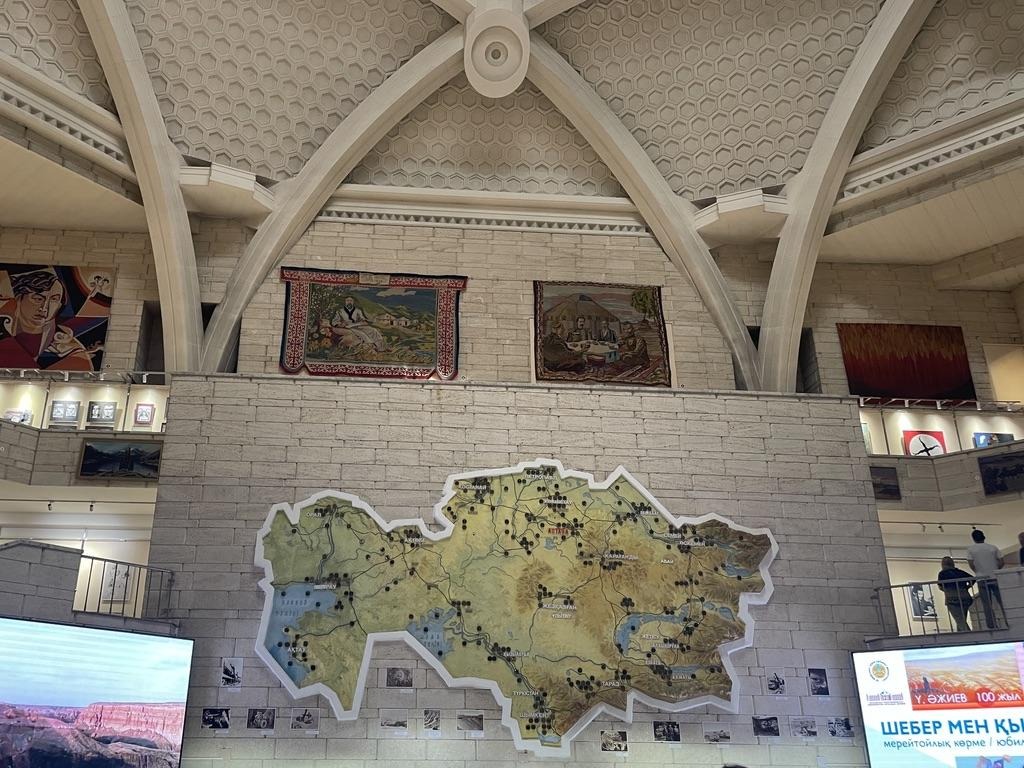
In June 2024, I set off to conduct fieldwork for my master’s thesis at the University of Helsinki, planning to interview members of the citizenry, local environmental organizations, and petroleum companies to understand how they perceive Kazakhstan’s energy sector and its evolving composition. After landing in Almaty, I spent my first afternoon at the Central State Museum in order to get a sense of the official narratives of the country’s history and culture. As I stepped through the massive Soviet-era doors, I was greeted by a gigantic map featuring the locations of Kazakhstan’s natural resources: fish icons in the Caspian Sea, farm animals in Shymkent, and oil wells in the west. This foregrounding of resources in the state-sponsored museum set the tone for the rest of my trip, as I traveled to seven cities, finding traces of Kazakhstan’s petroculture and identity along the way. Kazakhstan’s fossil fuel heritage has continued to dominate public representations of progress and modernity, even as policy has begun to gesture toward a green transition (Appadurai, 1996; Szeman, 2019).
Kazakhstan’s attachment to its fossil fuel industry dates to the country’s early days of independence. Its largest oil field, Tengiz, was discovered in the 1980s, just 12 years before the collapse of the Soviet Union and the birth of independent Kazakhstan. A permanent exhibit deeper in the Central State Museum details the development of Tengizchevroil, a consortium involving KazMunayGaz (Kazakhstan’s state petroleum company), Chevron, and ExxonMobil. The in-depth display shows photos of the initial signing of the consortium agreement with Chevron’s Chairman of the Board, Kenneth Derr, alongside President Nursultan Nazarbayev. Other photos show Nazarbayev inaugurating oil and gas plants, which stayed with me as I later traveled to Kazakhstan’s first solar park, Burnoye, just outside the city of Taraz. DuringWhile being given a tour of the facilities, I was shown a special platform constructed in 2015 from which Nazarbayev opened the plant. Energy, for Kazakhstan, has long been a stage, symbolically and physically, for state performance (Daggett, 2020).
A few weeks after my visit to the Central State Museum, I headed to Atyrau, Kazakhstan’s fossil fuel capital and the site of much of its oil and gas production. Paying a visit to the Atyrau Regional Museum, it was unsurprising to see a heavy focus on industry in the exhibits, which blend industrial pride and local identity. In this museum, oil workers are presented as heroic figures alongside artifacts of Kazakh traditional clothing, instruments, and yurts. Yet, this region has also seen its fair share of unrest, with a history of labor strikes. Larger uprisings across the country have been sparked several times by striking oil workers, particularly in Zhanaozen and surrounding towns. Most recently, the Bloody January events of 2022—a nationwide protest movement that was ultimately met with state violence—can be traced in part to long-standing grievances in oil towns such as these (Kudaibergenova & Laruelle, 2022). This aspect of Atyrau’s local character, as a site of resistance, is predictably absent from the narrative presented in this state-owned museum, underscoring how fossil fuel is both an economic driver and molds a curated story of national progress.
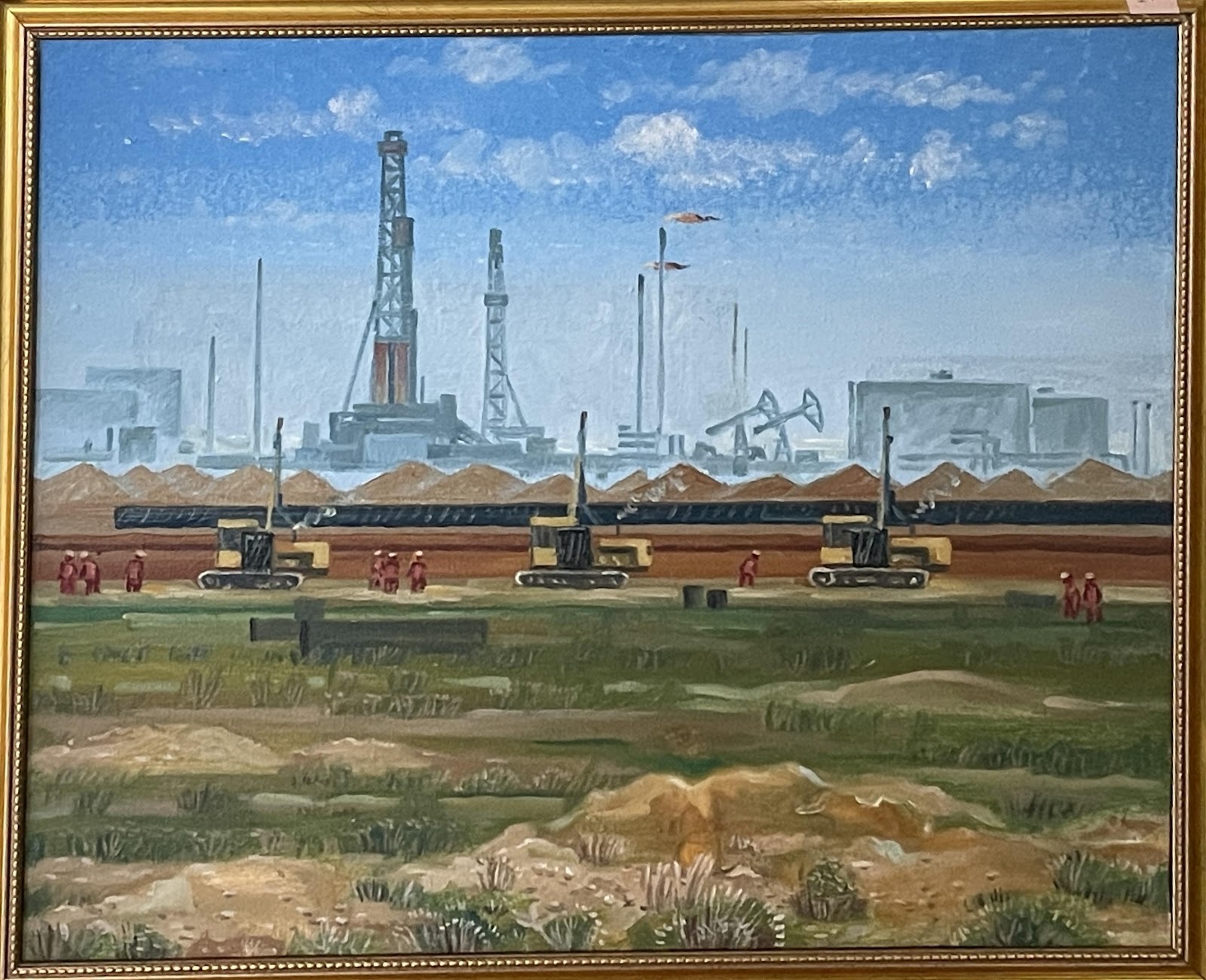
Similarly reflective of the national imaginary are Kazakhstan’s art museums. In the Kasteyev State Museum of Arts in Almaty and the Regional Art Museum in Atyrau, I perused brightly colored paintings of shiny oil rigs and factories, lending an aura of aestheticism and extractive modernity, rather than revealing the destructive truths behind the industrial activity. These artworks that arguably celebrate oil join the museum exhibits that honor oil workers, together forming a cultural infrastructure that glorifies fossil fuels and embeds them in Kazakhstan’s self-image.

Kazakhstan’s museums reveal a cultural infrastructure that continues to valorize oil, even as the state government solicits investment into renewables. They serve as altars to extractivism, where fossil fuels are not only economic assets but symbols of national identity. Energy transitions are technical and economic, as well as cultural and symbolic. If cultural narratives don’t evolve alongside policy, a phase out of fossil energy may remain stalled or hollow. Museums do not just serve as sites where energy histories are preserved but can also be space for a reimagining, shaping how societies can conceive possible futures (Caille, 2023). For Kazakhstan, this does not simply mean replacing oil with renewables but a confrontation of the uneven legacies and new challenges that any energy system may produce. Understanding energy transition, therefore, means looking past the carbon footprints to the paintings, museum halls, and public memory that reflect the cultural imaginaries sustaining a society’s relationship with energy and how to create space for imagining multiple energy futures.
Notes
Appadurai, Arjun. Modernity at Large: Cultural Dimensions of Globalization. University of Minnesota Press, 1996.
Daggett, Cara. “Energy and Domination: Contesting the Fossil Myth of Fuel Expansion.” Environmental Politics 30, no. 4 (2021): 644–62. https://doi.org/10.1080/09644016.2020.1807204.
Kudaibergenova, Diana T., and Marlène Laruelle. “Making Sense of the January 2022 Protests in Kazakhstan: Failing Legitimacy, Culture of Protests, and Elite Readjustments.” Post-Soviet Affairs 38, no. 6 (2022): 441–59. https://doi.org/10.1080/1060586X.2022.2077060.
Szeman, Imre. On Petrocultures: Globalization, Culture, and Energy. West Virginia University Press, 2019.
Vakulchuk, Roman, and Indra Overland. “Kazakhstan: Civil Society and Natural Resource Policy in Kazakhstan.” In Public Brainpower: Civil Society and Natural Resource Management, edited by Yijia Jing, 143–62. Springer International Publishing, 2017.
