12 Min Read
September 4, 2026
By
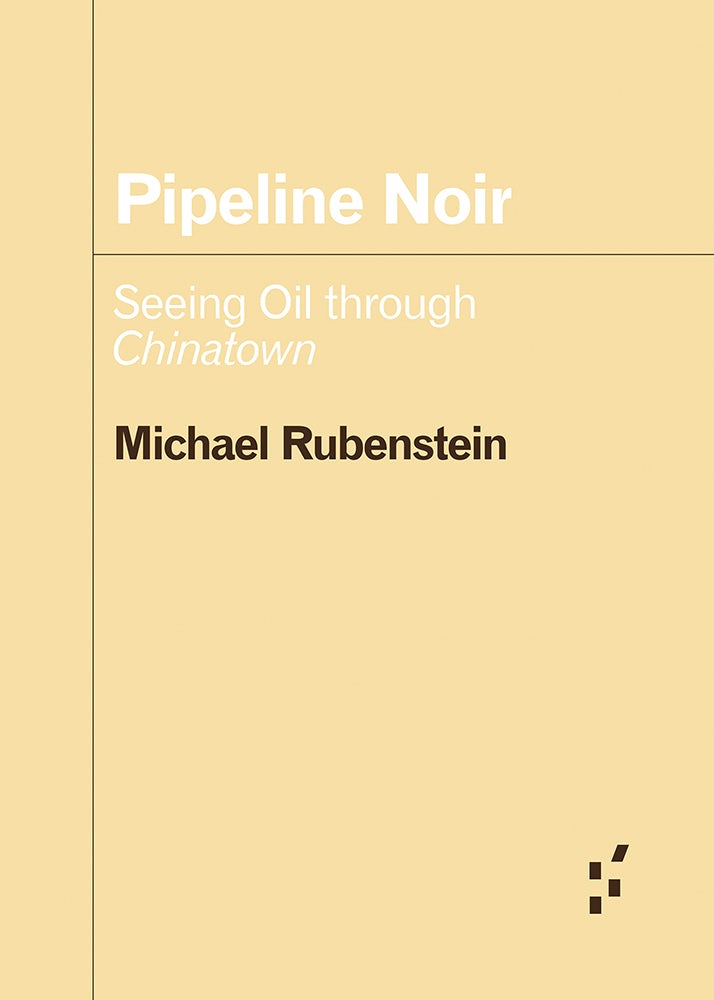
Michael Rubenstein is professor of English and director of the Humanities Institute at Stony Brook University. He is coauthor of Modernism and Its Environments and author of Public Works. His latest book, Pipeline Noir: Seeing Oil through Chinatown, rereads Chinatown as a document of petromodernity, tracing how pipelines, oil, and cinema shaped the twentieth-century American imagination. Pipeline Noir is available now from the University of Minnesota Press.

Pipeline Noir reassesses Chinatown fifty years after its initial release in 1974, arguing that the film’s enduring power derives in part from its thematization – on the levels of plot, style, and form – of the pipeline as the formative figure for the American 20th century. While a water pipeline (the Los Angeles Aqueduct) drives Chinatown’s historical plot in the 1930’s, an oil pipeline (the Trans-Alaska Pipeline System) surrounds the time of Chinatown’s making in the early 1970s. I reinterpret Chinatown as a quintessential document of petromodernity at a time when the United States was declaring, through its energy policy, its so-called “energy independence” in the same way that Los Angeles once declared its so-called water independence: by building an extractive pipeline. Chinatown makes uniquely visible a petromodernist cinematic style. Its camera eye is isomorphic with the aperture of the pipeline. Chinatown shows us the world viewed through what I call the petroscope. And the petroscope’s way of seeing – its style – I call pipeline noir.
Part of the argument of Pipeline Noir is that seeing oil in and through Chinatown is something that would have been much harder to do when the film was first released. Only as the film ages into the twenty-first century – as we confront global warming and the host of climate crises that are the result of oil’s hegemony – does the oil content of Chinatown become fully visible. In retrospect, we can see Chinatown as a document of petromodernity, or what Daniel Yergin refers to as “the Age of Hydrocarbon Man,” because we can compare it to something like 2015’s Mad Max: Fury Road. Though generically quite different, the films are more similar than they might seem at first glance. Both are about driving around looking for water in a desert landscape while struggling against an incestuous father who is responsible for an ongoing environmental catastrophe. The difference between them is that in pre-apocalyptic Chinatown the time in cars is spent cruising comfortably and reveling in some really snappy Chandleresque dialogue, while in post-apocalyptic Mad Max it is spent coal-rolling and careening around at top speed while shouting expletives like “Fang it!,” “Schlanger!,” and “Mediocre!.” This degradation of dialogue – as fantastically inventive and entertaining as it is – nevertheless reflects an historical progression whereby a new kind of civilization first invents itself with oil, and then goes on to destroy itself with it. The difference between the plots of Chinatown and Mad Max is little more than the difference between pre- and post- apocalypse.
Other films that came out of the New Hollywood era, in the late 1960s and early 1970s, were preoccupied with oil, if not directly then in the shape of its commodified forms. But what distinguished them from the historical drama of Chinatown is that they were set in their present. In a well-known scene from Mike Nichols’s The Graduate (1967) a middle-aged business man named McGuire tries to interest college grad Benjamin Braddock in a career in petroleum products: “I just want to say one word to you. Just one word. Plastics. There’s a great future in plastics. Think about it. Will you think about it?” Benjamin appears baffled by, indifferent to, and dissociated from McGuire’s solicitation, which is to say that plastics, at least in the abstract, turn him off.
Later in the film though, Benjamin has exactly the opposite reaction to being pitched a specific plastic: he is turned on by Mrs. Robinson’s seductive reverse-striptease with a nylon stocking, an iconic petroleum-based, cheap, mass-marketed substitute for rare, expensive silk. In another context we might think in Freudian terms of the stocking as a sexual fetish, but here, combined with McGuire’s ejaculation, “Plastics!” it also works as an oil fetish. Petroleum is in a sense the source of Benjamin’s affective disorders, a lure by which he is entranced and a trap from which he yearns to escape. The stocking here functions not only as a stand-in for petromodernity but also as an analog to film itself: a scotomic membrane that can be seen through, but that also makes itself seen, one that generates scopophilic sexual desire by simultaneously concealing and exposing. The still image taken from that scene graced the promotional posters for The Graduate, suggesting that what turned Benjamin on might also attract audiences. For critic Mike Tondre, once one notices the plastics motif in The Graduate, it becomes “hard to shake the thought that desire, reproduction, and the future itself might be bound up” with oil.
In his book Oil, Tondre also notes that another Jack Nicholson vehicle from 1970, Bob Rafelson’s Five Easy Pieces, is perhaps “the quintessential expression of the oil blues.” Nicholson plays Bobby Dupea, an upper-middle-class piano prodigy who has turned his back on that life to become an oil-field worker in Kern County, California. In a scene that evokes the “stasis and exhaustion” of the age of petromodernity, Dupea finds himself stuck in an interminable traffic jam in the California desert after work in the fields. He spies a piano on the bed of the truck in front of him, jumps out of his car, sits down at the piano, and begins playing Chopin. Dupea roleplays the nihilistic clown in a vision of automobile civilization nearing what felt, even as early as the 1970s, like its end.
Fifty years later, well into the twenty-first century, we find ourselves at the end of the end of the age of hydrocarbon humanity. “Petropolitics,” Dominic Boyer asserts, has now “entered its senescence.” Boyer doesn’t declare petropolitics dead; just because they’re in their senescence doesn’t mean they aren’t – like Chinatown’s baddie, Noah Cross – dangerous. Somewhere between Chinatown and Mad Max, let’s say mid-apocalypse, Bobby Dupea plays Chopin while stuck in a sea of idling cars baking in the desert heat of the extractive zone, a precursor figure for Immortan Joe’s pet pyromaniac guitarist in Fury Road. Those are both powerful images of the end of the end of hydrocarbon man. Chinatown’s pipelines are images of the beginning of the end, exemplars of petromodern style and pipeline noir. Looking at Chinatown and Fury Road together shows us, half a century after Chinatown, that we are still peering through the petroscope—still seeing things through oil.