12 Min Read
May 15, 2026
By
Dr. I.K. Allen is a political ecologist, anthropologist, and critical energy humanities scholar teaching and researching in the UK.
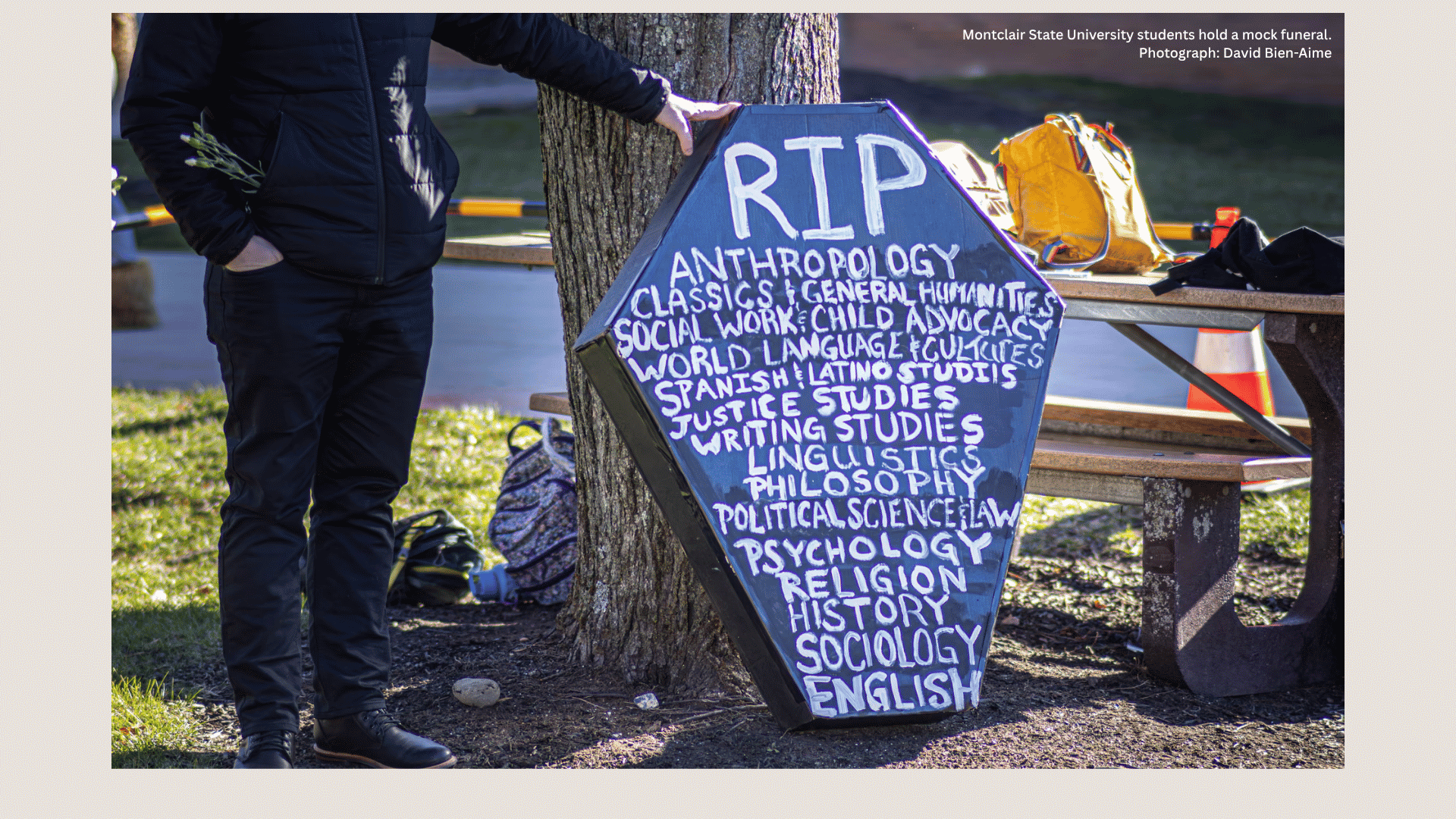
As we lurch from one violent, profit-making, fossil-fuelled energy crisis to another, and under increasing far-right control, higher education across the Global North—particularly the humanities—is at breaking point.1
This may seem like an elite irrelevancy. After all, the horrors and mass atrocities perpetrated daily are starker and more immediately urgent. Global food and fuel poverty and insecurity are skyrocketing. Looming shortages are predicted for even the wealthiest countries. Yet, Energy Humanities teaches us to make connections in previously unearthed places, often by slowing down—those of us with the privileges to do so—and peering deeply into the multi-layered, unfolding violences of our world.
In that vein, I want to ask: how do our continued dependence on fossil fuels, their brutal entrenchment via expanding alliances with authoritarian, right-wing elites—what Andreas Malm, myself and others in the Zetkin Collective term "fossil fascism"—and the existential collapse of the humanities intersect in this conjuncture?2 And what are the implications for our ability to make social and cultural sense of energy pasts, presents, and futures—the core focus of Energy Humanities scholarship—just at the point we need such critical faculties the most?
In the UK, where I am based, the situation for the humanities is dire. A 2025 Times Higher Education survey found that 49% of universities were terminating programs across the board, leading to over 4000 courses being axed—especially and disproportionately within the humanities, where the majority of graduates are women (see the US, UK, India for revealing statistics). Entire departments were closing in 18% of institutions. Brilliant centres in History, English, Philosophy, Anthropology, Human Geography, Modern Languages, Art, and Drama have been liquidated. Even those with well-established profiles and research excellence track records have been cut, creating an uneven geography of regional "cold spots" in provision and reducing access for already disadvantaged students. Simultaneously, last year, the Arts and Humanities Research Council (AHRC)—the core UK government funding body for humanities research—announced a 60% cut in student-led PhD funding.
By comparison, so-called STEM subjects, which are disproportionately male-dominated, are aligned with government economic "priorities," and offer more secure financial futures in the context of ballooning student debts, are in robust health, from school age onwards. In November 2025, UK Research & Innovation, a major public social science funding agency, intensified this trend by prioritizing research that "turbo-charges" economic growth, with major implications for "curiosity-led" research.
Explanations for this trend in a marketized higher education system include a government increasingly hostile to high-fee-paying international students amid rising anti-migrant rhetoric; declining domestic demand for subjects with high tuition costs and perceived limited career returns in a cost of living crisis; and a sector struggling under constrained public funding and mismanaged spending.
Is that the full story? I am not convinced.
With an EU-funded PhD that developed an ethnographic account of the emotional politics of energy transition from coal and its intersections with far-right populism in Poland, I am currently an Associate Lecturer on an interdisciplinary Masters programme in environmental change at a Russell Group university.3 Even here, the pressure is mounting. Fresh from teaching my students through the Energy Humanities literature that inspired and influenced my own work, I am awaiting word on a potential fixed-term contract extension, confronting the reality of growing casualization of UK academic labour amid sector-wide cuts involving tens of thousands of redundancies.
From this vantage point, I argue that what we are in fact witnessing is a petro-masculinist assault on our collective critical capacities to interrogate, resist, and dismantle Fossil Capital.4 "Petro-precarity" names this deliberate hollowing out and precaritisation of the very intellectual resources we need to understand and confront the racialized, gendered, and classed fossil-fueled capitalist crisis—and its increasingly fascistic form—enacted by a university sector marinated in, and increasingly materially allied to, oil's male-dominated interests: what I am calling, riffing on Timothy Mitchell (2011), the Carbon University.5 These are interests that also of course incorporate the keen promotion of fossil-fuel hungry generative AI attacking the humanities simultaneously via induced ‘cognitive surrender’.
As an estimated $30 million per hour pours into oil and gas company coffers amid an Iran "war-windfall", it is time those alliances are vividly illuminated, and more roundly and publicly rejected by scholars and institutional leadership alike, in both moral and material terms. Energy Humanities researchers, students, and publishers have a key role to play in resisting and fighting back against this destruction.
Let me explain.
The Making of the Carbon University
Since the mid-2010s, scholars, journalists, and activists have exposed higher education's ties to the fossil fuel industry worldwide, kick-starting the global divestment movement. In the UK, this has led to important successes, including 65% of universities pledging to divest from the industry in 2022. That figure rose to 72% by 2023, covering £17.7bn in fossil-fuelled endowment wealth. On paper, this is significant progress that should continue to build momentum. Yet focusing on divestment alone risks missing the more insidious story: the subtle but growing embeddedness of fossil capital within the everyday workings of the university itself, through incoming funding of research and centres, as much as within teaching and administration.
Investigations by openDemocracy reveal that over £147m of fossil-fuel money was pumped into at least 60 British universities between 2016 and 2023, despite the pledges that many of them made to divest from oil and gas. Cambridge, Oxford, and Imperial College London soaked up two-thirds of this sum, all of it for STEM subjects. Desmog reports that £41m of this arrived after the 2022 divestment pledges. Exeter University came under particular fire for signing a £14.7million, five-year deal with long-standing partner Shell to fund its carbon sequestration research. Meanwhile, Oxford accepted £8.2million in research grants between 2015-20 from fossil-fuel giants, funding departments like engineering, earth sciences, and business. Such stories led to an Open Letter from 500 leading scientists calling for an end to fossil-funding of especially climate research in 2022.
Yet greenwashing continues. At Cambridge, the university rebranded its physical sciences BP Institute in response to student protests (despite ostensibly signing the divestment pledge in 2020) only to introduce further loopholes in donor policies in 2024 and 2025. Cash from non-net-zero abiding fossil-fuel companies could still be accepted under "exceptional circumstances," meaning, absurdly, when the donation is large enough. Meanwhile, citing academic freedom, staff will not be prevented from continuing with "non-funded" fossil fuel collaborations.
Given the difficulty of accessing data, the scale of funding coming into universities and its influence is likely far greater than figures stated here, according to openDemocracy journalists. Universities frequently cite data protection and privacy laws to withhold information. Some have even lobbied the government to retain the right to keep donations secret. The rise of "dark money" in university accounts prompted another Open Letter from academics in 2024, calling for greater source transparency.
In the US, paradoxically, it is the Trump administration that has pushed for increased disclosure. In 2025, the Department of Education forced universities, including Ivy League brands, to reveal more than $5 billion in foreign gifts and contracts that year alone, much of it from authoritarian, fossil-capital-aligned regimes. The oil-state Qatar accounted for the greatest share (20%), making it the single largest contributor to US higher education, the second was from coal-giant China, and coming in fifth was Saudi Arabia.
The backdoor, then, remains wide open. Oil money is still finding ways to flow in, often through subterranean means and towards disciplines that support and affirm its interests. As institutions scramble for cash and oil interests seek new investment outlets, this trend only looks set to intensify.
What becomes of the University under such conditions?
A recent first-of-its-kind literature review in WIREs assesses research into fossil fuel and higher education links across the climate-culpable United States, Canada, UK, and Australia.6 While highlighting a notable lack of in-depth academic studies, the authors argue that, following decades of university corporatization and declining public funding, fossil fuel influence is now operating through a wide range of embedded mechanisms, making the sector a well-established yet under-researched "frontier" of fossil-fueled "climate obstructionism." While tactics such as funding think tanks and disinformation campaigns are well documented, far less attention has been paid, they state, to these embedded forms of influence within the everyday functioning of higher education.
From student recruitment events, scholarships, internships, and field trips to seats on governance boards, funding of research centres, endowed posts, and the sponsorship of conferences, the authors map a fossil fuel industry exerting a deep, wide-ranging, and often invisibilized influence over teaching, research, and administration. openDemocracy likewise found that energy companies increasingly shape course content, sit on advisory boards, and even advise on responses to Freedom of Information requests, including how to counter "anti-oil rhetoric."
Through such partnerships, fossil fuel companies seek to gain legitimacy, public trust, and policy credibility. They incentivize status quo discourses centered on incremental "fossil fuel solutionism" and "technological optimism" while shaping research agendas that can indirectly reproduce climate delay, doubt, and denial.7 As the authors note, these strategies echo those of the tobacco industry in the 1950s, alongside similar practices in the pharmaceutical, sugar, food, and lead industries—all of which have repeatedly been found to have considerable influence on research outputs, thus posing serious conflicts of interest. A recent example, published in Nature, finds fossil-funded research centres to be more favourable to carbon interests than to renewables.
By co-opting universities in this way, fossil capital has found itself an ally willing to serve and defend its interests behind closed doors in the name of ever-narrowly defined institutional self-preservation – largely STEM shaped. Through this set-up, the fossil fuel industry trades on the university's historic reputation as a public good while simultaneously corroding its very capacity to enact that role by transforming it beyond recognition. As Energy Humanities teaches us, energy is never just a neutral input. It refashions society and subjectivity in its own image. This refashioning extends to a reorganization of the very conditions of knowledge production and valuation within the Carbon University. Petro-precarity names this restructuring: the marginalization and precaritisation of the humanities, including its labour, at the very moment they are most needed.
This is not incidental. It is central to the growing fossil-fascistic agenda.
Fossil Fascism Undermining the Humanities
Corporate funding (thankfully!) rarely flows into the humanities because they simply do not pay, nor are they easily mobilized to defend fossil interests. Quite the opposite.
It is no coincidence that the humanities, at their best, develop emancipatory knowledge on colonialism, racism, and imperial histories, sexism, feminism, queer, trans, and intersectional identities, alongside critical analyses on fossil capitalism itself, as exemplified by the Energy Humanities field. The humanities cultivate the very capacities—historical, political, and ethical—that enable us to think against and to challenge entrenched configurations of power and inequality; capacities that Black feminist scholar bell hooks (1994) calls "practices of freedom."8 These are not, and will not be, high on the Carbon University's agenda. Exemplifying this trend most vividly, two universities of which I am an alumnus—both known as UK bastions of radical pedagogy (Goldsmiths and Sussex)—have faced repeated, severe dismembering.
The humanities cultivate the very capacities—historical, political, and ethical—that enable us to think against and to challenge entrenched configurations of power and inequality.
Given that the humanities are disproportionately composed of women, it is unsurprising that this is precisely the knowledge petro-masculine capital seeks to erase. In fact, women and gender studies programs are being specifically targeted. As Erin McCoy argues, what women and the humanities have in common is having to repeatedly declare the value of their existence in the face of such persistent obliteration. Another prime target is critical race studies – at Birmingham City University, the just-launched MA in Black Studies has been closed without consultation almost overnight, prompting a widely circulated petition.
This epistemic restructuring forging petro-precarity does not occur in a political vacuum. Across the UK, US, and Europe, right-wing actors, known for their hyper-masculine politics, having long driven the marketization of higher education, are increasingly targeting the humanities and critical social sciences as sites of "indoctrination" within the so-called "culture wars." Earlier this year, in the UK, Suella Braverman, former Home Secretary known for her hardline stance on migration, defected to Reform UK and was appointed Spokesperson for Education, Skills, and Equalities. She has placed universities "on notice," pledging to eliminate "mickey mouse courses" and "woke nonsense" if Reform gains power (which is not unlikely). In the US, citing similar concerns, the Trump administration abruptly canceled all National Endowment for the Humanities grants in 2025 to pivot towards "the President's agenda."
Across both sides of the Atlantic, these agendas are increasingly bank-rolled by fossil capital. In the UK, Reform has accepted £24 million from oil and gas, over two-thirds of its total funding, while Trump’s Republican party attracted $445 million from big oil in the last US election cycle alone. This connection is not merely indirect, however. A recent GoodLaw Project investigation has found that profits from refining Russian oilhave been used by networks linked to Hungary's former Prime Minister, Viktor Orbán, and his allies to gain access to institutions such as Cambridge andOxford and advance a far-right agenda.
The ensuing actions to de-fund the humanities form part of a broader political project to delegitimise precisely those forms of knowledge most capable of interrogating these alliances, alliances that even extend into increased surveillance-based activities shoring up authoritarian state control. Recent investigations revealed that universities paid security firms to monitor their own students and staff in relation to Palestine activism. These can be understood as structural features of the oil-soaked neoliberalisation of the university in an increasingly far-right-leaning world.
But they are not inevitable.
A Call to Action
Energy Humanities and allied researchers, students, and publishers have a key role to play in resisting this vandalism and the logics that accelerate it. The task is clear: to expose these entanglements, defend the spaces of critical inquiry that remain, and insist—loudly—on the necessity of the humanities for the future viability of any institution worthy of the name "University," rooted, after all, in the Latin for "whole."
Most crucially, we must move beyond internal silos and frictions and present a united front against the ongoing erosion of the broadly defined humanities.
Before it's too late.
Addendum, August 2026:
Since this article was published, the trajectory it describes has become yet more visible and stark. In June, the University of Exeter announced plans to put around 500 academic posts at risk of redundancy with 150 set to go. Cuts are predictably disproportionately concentrated (85%) in the humanities, arts and social sciences, including the closure of entire high-ranking degree courses. This is despite the elite University recently being ranked by a Sunday Times league table sixth among UK universities for overall financial health. A huge UCU-led staff mobilisation led to a flurry of media attention, a nearly 40,000-strong petition, and a vote of no confidence in the VC. Leading humanities staff and UCU argued that in the absence of an obvious financial rationale, the scale and distribution of the cuts pointed towards a deeper ideological logic.
At the same time, in July, 35 UK universities (including Exeter) have become founding members of the new Defence Universities Alliance, a £182 million government initiative bringing Higher Education into direct partnership with the Ministry of Defence, signalling a deepening alignment with the fossil-fuel-military-industrial complex. Its explicit aim is to "bring together academia and the Armed Forces”, ”boost defence industry skills” and "support vital research into new defence technologies.” Almost 100 of the UK’s approx.160 Universities applied to be part of this founding status. A campaign by Demilitarise Education called the Peace Universities Alliance has been launched in its wake.
These developments sharpen the critical question posed here: what kinds of knowledge are being protected and expanded within the Carbon University, what kinds are being positioned to disappear, and with what consequences?
Notes
1. By “humanities” I am here referring to both the arts and social sciences.
2. Andreas Malm and the Zetkin Collective, Black Skin, White Fuel: On the Danger of Fossil Fascism (Verso, 2021).
3. I. K. Allen, Dirty Coal: Industrial Populism as Purification in Poland’s Mining Heartland (PhD diss., KTH Royal Institute of Technology, 2021).
4. Cara Daggett, “Petro-masculinity: Fossil Fuels and Authoritarian Desire,” Millennium: Journal of International Studies 47, no. 1 (2018): 25–44; Andreas Malm, Fossil Capital: The Rise of Steam Power and the Roots of Global Warming (Verso, 2016).
5. Timothy Mitchell, Carbon Democracy: Political Power in the Age of Oil (Verso, 2011).
6. Sara Hiltner et al., “Fossil Fuel Industry Influence in Higher Education: A Review and a Research Agenda,” Wiley Interdisciplinary Reviews: Climate Change 15, no. 6 (2024): e904.
7. Hiltner et al., “Fossil Fuel Industry Influence in Higher Education.”
8. bell hooks, Teaching to Transgress: Education as the Practice of Freedom (Routledge, 1994).
