12 Min Read
May 3, 2026
By
Juan Felipe Hernandez Gomez is a historian of Latin American extraction, literature, and environmental politics. He holds a PhD in Hispanic Studies from UBC, an MA in Public History from UMass, and a BA in History from the University of Florida. His research focuses on twentieth-century mineral narratives in Peru, Bolivia, Chile, and Colombia, and he has taught history, anthropology, and political science in Canada.
“Tiehm’s buckwheat shouldn’t be wiped off the face of the Earth by an open-pit mine.”1
In the high desert of northern Nevada, a small yellow wildflower (Eriogonum tiehmii), commonly known as Tiehm’s buckwheat, has come to stand in the path of a lithium mine. In Chile’s Atacama Desert, vast salt flats shimmer beneath the sun, harboring microbial extremophiles and flamingos whose survival depends on brines now targeted for lithium extraction.2 These two sites, Rhyolite Ridge in Nevada and the Salar de Llamara in northern Chile, are separated by thousands of kilometers, languages, and legal systems. Yet they are bound by a single mineral and a single paradox: the accelerating destruction of specific forms of life in the name of planetary survival.
These imminent cases of possible extinction prompt us to think: What happens when the promise of decarbonization demands the destruction of desert plants, microbial ecologies, and brine-dependent species? What does it mean to extinguish life in order to “save the planet”? The conflict at Rhyolite Ridge and the anticipated transformations at Llamara compel us to confront the violence embedded in the so-called green transition and to rethink the ethical grammar that underpins the infrastructure of sustainability.
The Tiehm’s buckwheat flower grows only on a few acres of lithium-rich clay soils in Nevada’s Silver Peak Range. This range is an isolated and desertic mountain system running across the southwest Esmeralda County and contiguous to California. The flower appears fragile against the vast desert landscape, yet its existence has proven resilient.3 The proposed lithium-boron mine, however, would remove much of the habitat on which the plant depends. The plant is directly threatened due to the lithium company’s plans to set up an extraction site. “Australian mining company Ioneer is looking to build a $600 million mine on the site.”4
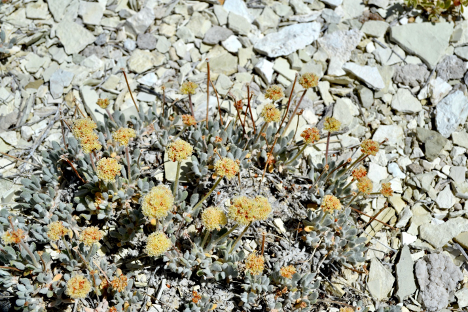
In addition to the threat that the mining company poses, the plant also has another problem: climate change. The species is endangered because the continuous droughts and extreme weather of the region have altered patterns of rainfall and humidity levels. The warming of the planet and the extremes brought by climate change in Nevada are damaging the existing specimens and forcing local fauna like the white-tailed antelope ground squirrel to feed on its leaves and stems.
We can say with confidence that the plant will eventually disappear either because of “the mine’s construction which would destroy 60% of the remaining Tiehm’s buckwheat habitat during its first phase, and up to 90% with subsequent construction phases” or because the trends in climate patterns have put additional pressure on the ecosystem (extended droughts) and the changing eating behaviour of other species who have incorporated the plant into their diets.5 The buckwheat is not charismatic in the conventional sense, but its power lies precisely in its smallness and its specificity. The specificity of the plant disrupts the smooth narrative of the energy “transition” by insisting that decarbonization has a geography and that this geography includes unique forms of life worth saving.
The tragic fate of Tiehm’s buckwheat flower reminds us of the dangers of “backgrounding” nonhuman life, that is, the human tendency to treat ecological others as inert matter in the service of human projects. Australian environmental philosopher Val Plumwood warned against precisely that epistemological operation. Our modern habit of relegating nature to a role that allows usefulness without requiring moral considerability.6 In the discourse of green growth, lithium and other “critical minerals” appear as a neutral resource, a technical input, a sort of dead matter for human use. It just goes without saying as well as without thinking. The desert, with all its capacity to hold varied life-forms, simply becomes substrate. The buckwheat resists backgrounding, and it makes evident the entanglement of geology and biology, of mineral life or life-dependant-on-minerals. We have heard countless times that lithium extraction is justified as necessary to prevent climate catastrophe—a catastrophe that threatens biodiversity on a planetary scale.
What happens when the promise of decarbonization demands the destruction of desert plants, microbial ecologies, and brine-dependent species? What does it mean to extinguish life in order to "save the planet"?
Yet at Rhyolite Ridge, climate mitigation threatens to eliminate a species found nowhere else on Earth. The flower becomes a site where scales collide: the global atmosphere versus a local ecosystem, planetary futures versus endemic survival.
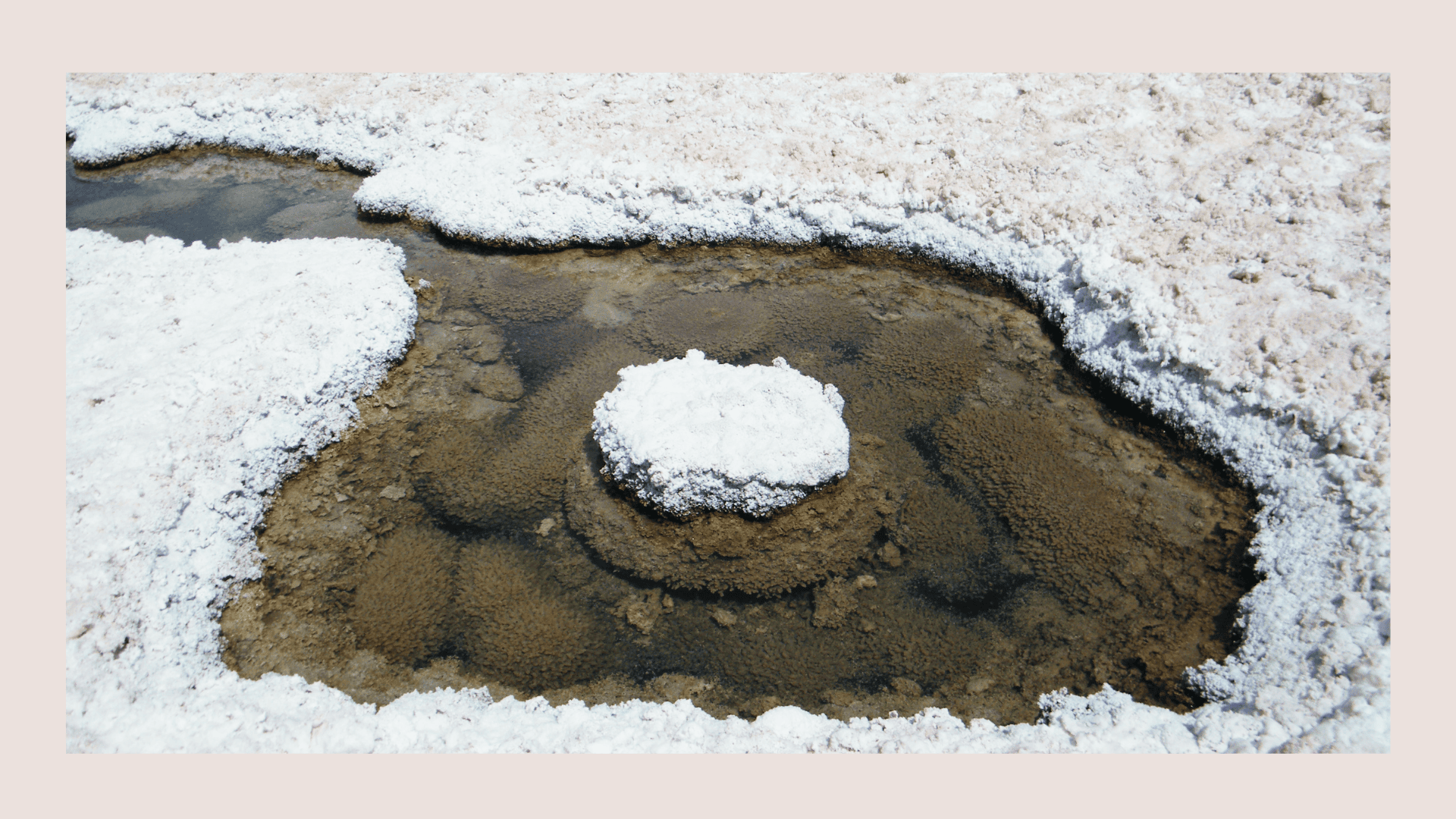
If Nevada’s buckwheat dramatizes the fragility of endemic terrestrial life, the salt flats of northern Chile reveal another dimension of ecological precarity: the possibility of ending entire life forms and systems that are exceptionally resistant to natural factors but vulnerable to humans. To the untrained eye, the salar appears barren and lifeless: a white expanse under an unforgiving sun. Yet this apparent emptiness conceals intricate ecologies. Hypersaline lagoons host microbial communities that have adapted to extreme conditions: high salinity, intense ultraviolet radiation, and scarce nutrients.
We know that these ecologies are in constant danger by the type of lithium extraction that takes place in the salt flats. Extraction in these environments typically involves pumping brine to the surface and allowing it to evaporate in vast ponds, concentrating the lithium over time. Even newer technologies that promise reduced water use or “direct lithium extraction” DLE remain dependent on brine chemistry and hydrological systems.7 Proponents see the Llamara project as an opportunity for environmentally responsible lithium production. Canadian company Summit Nanotech’s DLE technology is marketed as a more sustainable alternative to conventional salt-pond evaporation, potentially offering water recovery and reduced environmental footprints by using renewable energy. This framing aligns with the Chilean government’s broader strategy to position the country as a leader in sustainable lithium extraction. But the forceful removal of brine or any alteration of the water flows, however, can disrupt subterranean aquifers and surface lagoons in ways that are not fully understood and have further effects on other interconnected water systems that sustain life in the area.

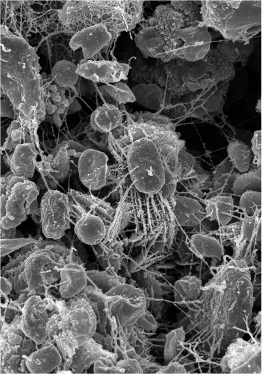
It is precisely in these lagoons that we can find the extremophiles. They owe their name to the impressive fact that they are able to live and thrive in extreme environments. The root of the word extremophile from Latin extremus ‘extreme’ and Ancient Greek philía ‘love’ describes these life-forms. Extremophiles are not marginal curiosities. Microbiologists found that approximately 3,500 million years ago, the conditions for life on Earth emerged thanks to these microbes. Invisible to the human eye, these organisms are simple beings, made of a single cell, yet they were the first to generate ozone and oxygen on Earth.
Extremophiles, in fact, reveal something about ourselves much deeper than we would believe. What is perhaps more astonishing that the capacity of these organisms to survive in extreme conditions such as extreme UV radiation, heat, cold, high salinity, acidity, and pressure is the fact that the new planetary mining (Arboleda) and specifically lithium extracting companies have demonstrated that even organisms living inside hot rocks buried several feet deep under the earth’s surface are not safe from our machinic regime of destruction called planetary mining. This play of extremes should make us think: is our appetite for earth’s minerals more extreme than the extremophiles’ incredible adaptation and conatus?
The Atacama has often been portrayed as a sacrifice zone, a landscape already shaped by nitrate and copper extraction. Yet the salar is not merely a backdrop to human industry. It is a site of ongoing biological creativity. The thirst for lithium, driven by imaginaries of millions of operating electric vehicles, unlimited grid storage, and the promise of “clean energy,” risks transforming these ecosystems in Atacama as well as Nevada into infrastructures of destruction, perhaps the future Chernobyls of the green transition.
Philosopher Elizabeth Povinelli has described late liberalism as marked by a distinction between “Life” and “Nonlife,” in which certain forms of existence are valued while others are rendered disposable. In the salar, this distinction becomes unstable: the brine itself is a medium of life. The boundary between mineral and organism blurs in microbial mats that metabolize the very salts targeted for extraction. To drain the brine is not simply to remove a resource; it is to intervene in a living system whose temporalities exceed human planning cycles. The contradiction of “killing life to save the planet” takes on microbial but also planetary dimensions. The green transition depends on brines that sustain extremophiles.
In seeking to stabilize the global climate, we may destabilize microclimates that have persisted for thousands of years. At both Rhyolite Ridge and Llamara, lithium is constantly framed as a substitute: for fossil fuels, for internal combustion engines, for carbon-intensive grids. Substitution and transition seem to be central to modern environmental policy. We replace coal with solar, gasoline with batteries, and combustion with electrification. The logic is compelling and often necessary. Yet substitution can obscure “composition” or the assemblages of the world, the intricate mesh (Morton) that sustains life. Lithium is not simply inserted into a vacuum left by oil. It emerges from specific landscapes, hydrologies, and ecologies. Each substitution entails a displacement, each displacement a possible end of life.
To kill extremophiles is not to eliminate a form of life that mirrors our own. It is to erase a mode of existence radically different from human embodiment. This raises a deeper question: Is sustainability only about preserving the conditions for human civilization, or does it entail a commitment to the flourishing of diverse life forms, even those that do not serve us? The rhetoric of the energy transition often frames lithium as indispensable. But indispensability is a political and economic category, not a metaphysical one: indispensable for whom, and at what cost? What is perhaps worst is that the conflicts at Rhyolite Ridge and the Salar de Llamara are not anomalies. They are symptoms of a broader condition for sustaining human life and human habits: the mineralization of the green future, simply because as demand for lithium grows, more deserts, salt flats, and mountain ranges will be reimagined as simple battery landscapes.
Perhaps what is required is a form of ecological humility: an acknowledgment that even our most well-intentioned projects are entangled with violence. Such humility does not paralyze action. It complicates it. It demands that the rush for lithium be tempered by care, by restraint, and by an expanded sense of who, or what, counts in the calculus of survival. In the end, the yellow buckwheat and the almost invisible extremophile pose the same question: Can a green future be built without repeating the sacrificial patterns of the past? The answer will not be found in lithium alone, but in the ethical frameworks we bring to the landscapes from which it is drawn.
Notes
1. Patrick Donnelly, “Tiehm’s Buckwheat Proposed for Endangered Species Act Protection: Rare Nevada Wildflower Is Threatened with Extinction by Lithium Mine,” Center for Biological Diversity, June 3, 2021, https://biologicaldiversity.org/w/news/press-releases/tiehms-buckwheat-proposed-for-endangered-species-act-protection-2021-06-03/
2. Javiera Barandiarán, Living Minerals: Nature, Trade, and Power in the Race for Lithium (MIT Press, 2026), 30.
3. Jamey D. McClinton, Robert K. Shriver, and Elizabeth A. Leger, “Ecology of Eriogonum tiehmii, a Rare Soil Specialist: Arthropod Diversity, Soil Preferences, and Demography,” Ecosphere 13, no. 8 (Aug. 2022): e4187, https://esajournals.onlinelibrary.wiley.com/doi/10.1002/ecs2.4187.
4. Molly Taft, “A Rare Flower Is Screwing Up Plans for a Nevada Lithium Mine,” Gizmodo, June 7, 2021, https://gizmodo.com/a-rare-flower-is-screwing-up-plans-for-a-nevada-lithium-1847045531.
5. Taft, “A Rare Flower Is Screwing Up Plans for a Nevada Lithium Mine.”
6. Joy A. Palmer, David E. Cooper, and Peter Blaze Corcoran, eds., Fifty Key Thinkers on the Environment (Routledge, 2001), 238.
7. “What Is Direct Lithium Extraction?,” Lithium Harvest, March 17, 2025, https://lithiumharvest.com/knowledge/lithium-extraction/what-is-direct-lithium-extraction/.

_(50145375913).jpg)
